Sunday, May 31, 2015

Holy Pentecost


Commemorated on May 31

In the Church’s annual liturgical cycle, Pentecost is “the last and great day.” It is the celebration by the Church of the coming of the Holy Spirit as the end—the achievement and fulfillment—of the entire history of salvation. For the same reason, however, it is also the celebration of the beginning: it is the “birthday” of the Church as the presence among us of the Holy Spirit, of the new life in Christ, of grace, knowledge, adoption to God and holiness.

This double meaning and double joy is revealed to us, first of all, in the very name of the feast. Pentecost in Greek means fifty, and in the sacred biblical symbolism of numbers, the number fifty symbolizes both the fulness of time and that which is beyond time: the Kingdom of God itself. It symbolizes the fulness of time by its first component: 49, which is the fulness of seven (7 x 7): the number of time. And, it symbolizes that which is beyond time by its second component: 49 + 1, this one being the new day, the “day without evening” of God’s eternal Kingdom. With the descent of the Holy Spirit upon Christ’s disciples, the time of salvation, the Divine work of redemption has been completed, the fulness revealed, all gifts bestowed: it belongs to us now to “appropriate” these gifts, to be that which we have become in Christ: participants and citizens of His Kingdom.

THE VIGIL OF PENTECOST

The all-night Vigil service begins with a solemn invitation:

“Let us celebrate Pentecost, the coming of the Holy Spirit,
The appointed day of promise, and the fulfillment of hope,
The mystery which is as great as it is precious.”

In the coming of the Spirit, the very essence of the Church is revealed:

“The Holy Spirit provides all,
Overflows with prophecy, fulfills the priesthood,
Has taught wisdom to illiterates, has revealed fishermen as theologians,
He brings together the whole council of the Church.”

In the three readings of the Old Testament (Numbers 11:16-17, 24-29; Joel 2:23-32; Ezekiel 36:24-28) we hear the prophecies concerning the Holy Spirit. We are taught that the entire history of mankind was directed towards the day on which God “would pour out His Spirit upon all flesh.” This day has come! All hope, all promises, all expectations have been fulfilled. At the end of the Aposticha hymns, for the first time since Easter, we sing the hymn: “O Heavenly King, the Comforter, the Spirit of Truth...,” the one with which we inaugurate all our services, all prayers, which is, as it were, the life-breath of the Church, and whose coming to us, whose “descent” upon us in this festal Vigil, is indeed the very experience of the Holy Spirit “coming and abiding in us.”

Having reached its climax, the Vigil continues as an explosion of joy and light for “verily the light of the Comforter has come and illumined the world.” In the Gospel reading (John 20:19-23) the feast is interpreted to us as the feast of the Church, of her divine nature, power and authority. The Lord sends His disciples into the world, as He Himself was sent by His Father. Later, in the antiphons of the Liturgy, we proclaim the universality of the apostles’ preaching, the cosmical significance of the feast, the sanctification of the whole world, the true manifestation of God’s Kingdom.

THE VESPERS OF PENTECOST

The liturgical peculiarity of Pentecost is a very special Vespers of the day itself. Usually this service follows immediately the Divine Liturgy, is “added” to it as its own fulfillment. The service begins as a solemn “summing up” of the entire celebration, as its liturgical synthesis. We hold flowers in our hands symbolizing the joy of the eternal spring, inaugurated by the coming of the Holy Spirit. After the festal Entrance, this joy reaches its climax in the singing of the Great Prokeimenon:

“Who is so great a God as our God?”

Then, having reached this climax, we are invited to kneel. This is our first kneeling since Easter. It signifies that after these fifty days of Paschal joy and fulness, of experiencing the Kingdom of God, the Church now is about to begin her pilgrimage through time and history. It is evening again, and the night approaches, during which temptations and failures await us, when, more than anything else, we need Divine help, that presence and power of the Holy Spirit, who has already revealed to us the joyful End, who now will help us in our effort towards fulfillment and salvation.

All this is revealed in the three prayers which the celebrant reads now as we all kneel and listen to him. In the first prayer, we bring to God our repentance, our increased appeal for forgiveness of sins, the first condition for entering into the Kingdom of God.

In the second prayer, we ask the Holy Spirit to help us, to teach us to pray and to follow the true path in the dark and difficult night of our earthly existence. Finally, in the third prayer, we remember all those who have achieved their earthly journey, but who are united with us in the eternal God of Love.

The joy of Easter has been completed and we again have to wait for the dawn of the Eternal Day. Yet, knowing our weakness, humbling ourselves by kneeling, we also know the joy and the power of the Holy Spirit who has come. We know that God is with us, that in Him is our victory.

Thus is completed the feast of Pentecost and we enter “the ordinary time” of the year. Yet, every Sunday now will be called “after Pentecost”—and this means that it is from the power and light of these fifty days that we shall receive our own power, the Divine help in our daily struggle. At Pentecost we decorate our churches with flowers and green branches—for the Church “never grows old, but is always young.” It is an evergreen, ever-living Tree of grace and life, of joy and comfort. For the Holy Spirit—“the Treasury of Blessings and Giver of Life—comes and abides in us, and cleanses us from all impurity,” and fills our life with meaning, love, faith and hope.

Father Alexander Schmemann (1974)

SOURCE:

SAINT OR FEAST POSTED THIS DATE 2014(with 2013's link here also and further:, 2012, 2011, 2010, 2009 and even 2008!):

Saturday, May 30, 2015

Memorial Saturday of the Holy Fathers of the First Ecumenical Council


Today we remember all pious and Orthodox Christians who have fallen asleep in the Lord, and also recall the dread Day of Judgment. May Christ our God be merciful to them, and to us.

Two Epistles (Acts 28:1-31, I Thess. 4:13-17) and two Gospels (JN 21:14-25, JN 5:24-30) are appointed to be read at Liturgy. The readings from Acts and the Gospel of St John, which began on Pascha, now come to an end. The book of Acts does not end, as might be expected, with the death of Sts Peter and Paul, but remains open-ended.

In his article “With all the Saints,” Fr Justin Popovich says that the Lives of the Saints are nothing less than a “continuation of the Acts of the Apostles.” Just as the book of Acts describes the works of Christ which the Apostles accomplished through Christ, Who was dwelling in them and working through them, the saints also preach the same Gospel, live the same life, manifest the same righteousness, love, and power from on High. As we prepare for the Sunday of All Saints, we are reminded that each of us is called to a life of holiness.

On this seventh Saturday of Pascha, St John Chrysostom’s “Homily on Patience and Gratitude” is appointed to be read in church. It is also prescribed to be read at the funeral service of an Orthodox Christian.

SOURCE:

SAINT OR FEAST POSTED THIS DATE 2014(with 2013's link here also and further:, 2012, 2011, 2010, 2009 and even 2008!):
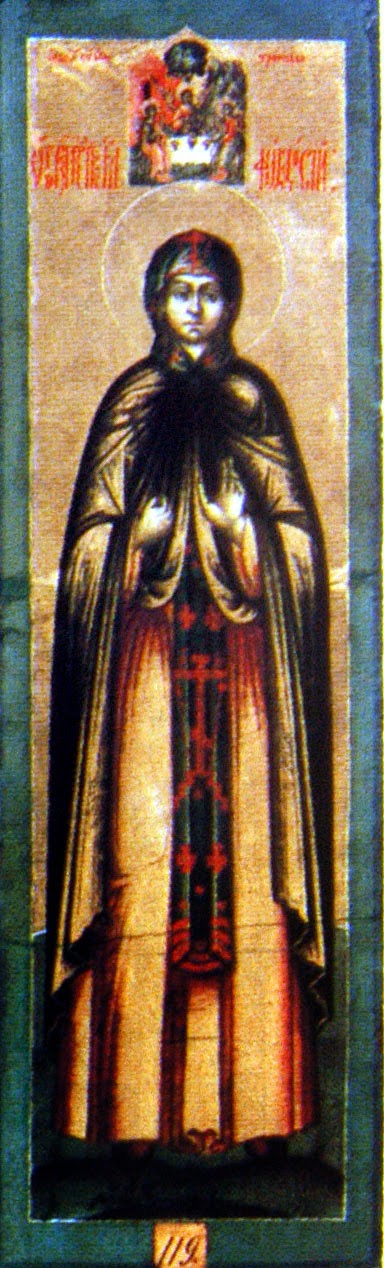
Friday, May 29, 2015

Virginmartyr Theodosia of Tyre

Commemorated on May 29

Saint Theodosia of Tyre lived during the third and fourth centuries. Once, during a persecution against Christians, which had already lasted for five years, the seventeen-year-old Theodosia went up to condemned Christian prisoners in the Praetorium in Caesarea, Palestine. It was the day of Holy Pascha, and the martyrs spoke about the Kingdom of God. St Theodosia asked them to remember her before the Lord, when they should come to stand before Him.

Soldiers saw that the maiden bowed to the prisoners, and they seized her and led her before the governor, Urban. The governor advised the maiden to offer sacrifice to the idols but she refused, confessing her faith in Christ. Then they subjected the saint to cruel tortures, raking her body with iron claws until her bones were exposed.

The martyr was silent and endured the sufferings with a happy face, and to a second suggestion by the governor to offer sacrifice to the idols she answered, “You fool, I have been granted to join the martyrs!” They threw the maiden with a stone about her neck into the sea, but angels drew her out from the depths. Then they threw the martyr to the wild beasts to be eaten by them. Seeing that the beasts would not touch her, they cut off her head.

By night St Theodosia appeared to her parents, who had tried to talk their daughter into not going to the sufferings. She was in bright garb with a crown upon her head and a luminous gold cross in her hand, and she said, “Behold the great glory of which you wanted to deprive me!”

The Holy Martyr Theodosia of Tyre suffered for Christ in the year 307 or 308. On May 29 we commemorate the transfer of her relics to Constantinople and Venice. She is also commemorated on April 3.

SOURCE:

SAINT OR FEAST POSTED THIS DATE 2014(with 2013's link here also and further:, 2012, 2011, 2010, 2009 and even 2008!):

Thursday, May 28, 2015

St Ignatius the Bishop and Wonderworker of Rostov


Saint Ignatius was Bishop of Rostov, and shepherded his flock for twenty-six years. After his death on May 28, 1288, his body was brought to the church. Some people saw him leave his coffin, and float in the air above the church. He blessed the people and the city, then went back to his coffin.

Many miracles took place at his grave.

SOURCE:

SAINT OR FEAST POSTED THIS DATE 2014(with 2013's link here also and further:, 2012, 2011, 2010, 2009 and even 2008!):

Tuesday, May 26, 2015

Carpos, Apostle of the 70

May 26

Reading:
 
This holy Apostle was numbered with the Seventy, and ministered unto the holy Apostle Paul, journeying with him and conveying his epistles unto those to whom they were written. He became Bishop of Beroea in Thrace, where he endured great tribulations while bringing many of the heathen to holy Baptism, and also suffered martyrdom there. Saint Paul mentions him in II Timothy 4:13.

Apolytikion of Carpos of the 70 in the Third Tone
 
O Holy Apostle Carpos, intercede to our merciful God, that He may grant our souls forgiveness of sins.

Kontakion of Carpos of the 70 in the Fourth Tone
 
Having thee, O ven'rable Apostle Carpos, as a bright and shining star, the Church is ever made to shine with thine innum'rable miracles. Save them that faithfully honour thy memory.

SOURCE:

SAINT OR FEAST POSTED THIS DATE 2014(with 2013's link here also and further:, 2012, 2011, 2010, 2009 and even 2008!):

Monday, May 25, 2015

Hieromartyr Urban the Pope of Rome

Commemorated on May 25

Pope St. Urban I of Rome? (222-230)

Pace Giovanni Battista de Rossi, Pope St. Urban I of Rome is one of the martyrs who was buried in the Catacomb of Praetextatus (Kirsch).


SOURCE:

SAINT OR FEAST POSTED THIS DATE 2014(with 2013's link here also and further:, 2012, 2011, 2010, 2009 and even 2008!):

Sunday, May 24, 2015

Fathers of the 1st Council


Reading:
 
The heresiarch Arius was a Libyan by race and a protopresbyter of the Church of Alexandria. In 315, he began to blaspheme against the Son and Word of God, saying that He is not true God, consubstantial with the Father, but is rather a work and creation, alien to the essence and glory of the Father, and that there was a time when He was not. This frightful blasphemy shook the faithful of Alexandria. Alexander, his Archbishop, after trying in vain to correct him through admonitions, cut him off from communion and finally in a local council deposed him in the year 321. Yet neither did the blasphemer wish to be corrected, nor did he cease sowing the deadly tares of his heretical teachings; but writing to the bishops of other cities, Arius and his followers requested that his doctrine be examined, and if it were unsound, that the correct teaching be declared to him. By this means, his heresy became universally known and won many supporters, so that the whole Church was soon in an uproar.

Therefore, moved by divine zeal, the first Christian Sovereign, Saint Constantine the Great, the equal to the Apostles, summoned the renowned First Ecumenical Council in Nicaea, a city of Bithynia. It was there that the shepherds and teachers of the Church of Christ gathered from all regions in the year 325. All of them, with one mouth and one voice, declared that the Son and Word of God is one in essence with the Father, true God of true God, and they composed the holy Symbol of Faith up to the seventh article (since the remainder, beginning with "And in the Holy Spirit," was completed by the Second Ecumenical Council). Thus they anathematized the impious Arius of evil belief and those of like mind with him, and cut them off as rotten members from the whole body of the faithful.

Therefore, recognizing the divine Fathers as heralds of the Faith after the divine Apostles, the Church of Christ has appointed this present Sunday for their annual commemoration, in thanksgiving and unto the glory of God, unto their praise and honour, and unto the strengthening of the true Faith.


Apolytikion of Fathers of the 1st Council in the Plagal of the Fourth Tone
 
You are greatly glorified, O Christ our God, who established our Fathers as luminaries upon the earth, and through them led us all to the true Faith. O Most compassionate, glory to You.

Kontakion of Fathers of the 1st Council in the Plagal of the Fourth Tone
 
The Church was strengthened into one faith through the preaching of the Apostles and the doctrines of the Fathers. The Church is robed in truth woven of the word of God from above. It teaches truth, and glorifies the great mystery of faith.

SOURCE:

SAINT OR FEAST POSTED THIS DATE 2014(with 2013's link here also and further:, 2012, 2011, 2010, 2009 and even 2008!):

Saturday, May 23, 2015

Right-believing Prince Basil of Yaroslavl

Commemorated on May 23

The celebration of the Synaxis of the Rostov and Yaroslav Saints on May 23 was established by resolution of His Holiness Patriarch Alexis I (+ 1970) and the Holy Synod of the Russian Orthodox Church, on March 10, 1964.

The holy right-believing Prince Basil is also commemorated on June 8 and July 3.


SOURCE:

SAINT OR FEAST POSTED THIS DATE 2014(with 2013's link here also and further:, 2012, 2011, 2010, 2009 and even 2008!):

Wednesday, May 20, 2015

Martyr Thallelaeus, Alexander and Asterius at Aegae in Cilicia

Commemorated on May 20

The Martyrs Thallelaeus, Alexander and Asterius lived during the reign of Numerian (283-284). The prefect of the city of Aegea sent soldiers to seek out Christians. They brought to him Thallelaeus, an eighteen-year-old blond-haired youth. To the prefect’s questions St Thallelaeus replied, “I am a Christian, a native of Lebanon. My father, Beruchius, was a military commander, and my mother was named Romylia. My brother is a subdeacon. I, however, am studying medicine under the physician Macarius. During a former persecution against Christians in Lebanon, I was brought before the prefect Tiberius, and barely escaped execution. But now that I stand before this court, do with me as you will. I wish to die for Christ my Savior and my God, and hope to endure all torments with His help.”

The enraged prefect ordered the two torturers Alexander and Asterius to bore through the knees of the martyr, pass a rope through the bone, and suspend him head downwards. But the executioners, by God’s design, bored into a block of wood, which they hung up in place of the


The Martyr Thallelaeus

martyr. When the prefect saw that they had deceived him, he then ordered that Alexander and Asterius be whipped. They also confessed themselves Christians and glorified God. The prefect immediately gave orders to cut off their heads. Twice he attempted to carry out the execution, and to bore through the saint’s knees, but the grace of God prevented him. Then he commanded that St Thallelaeus be drowned.

The returning servants reported to the prefect that they had carried out the execution, but just as they finished their report, St Thallelaeus appeared in white raiment. For a long time everyone was numbed with terror, but finally the prefect said, “Behold, this sorcerer has bewitched even the sea.”

Then one of his advisers, the magician Urbician, told the prefect to have the martyr thrown to the wild beasts. But neither the vicious bear, not the hungry lion and lioness, would touch the saint, all meekly lay down at his feet. Seeing this happen, the people began to shout, “Great is the God of the Christians. O God of Thallelaeus, have mercy on us!”

The crowd seized Urbician and threw him to the beasts, which did not hesitate to tear the magician apart. Finally, the prefect gave orders to kill the holy martyr with a sword. They led Christ’s martyr to the place of execution, called Aegea, where he prayed to God and bent his neck beneath the sword. This occurred in the year 284.

The relics of the holy martyr Thallelaeus are in the church of St Agathonicus of Constantinople and have performed many miracles. St Thallelaeus treated the sick without payment. For this reason, the Church calls him an Unmercenary Physician. He is invoked in prayers for the sick in the Mystery of Holy Unction, and during the Blessing of Waters.

TROPARION - TONE 4

Your holy martyr Thalelaeus and his companions, O Lord, / through their sufferings have received incorruptible crowns from You, our God. / For having Your strength, they laid low their adversaries, / and shattered the powerless boldness of demons. / Through their intercessions, save our souls!

KONTAKION - TONE 3

Revealed as a fellow struggler with the martyrs, / you were a perfect soldier of the King of Glory. / Through your trials and torments / you humbled the arrogance of the idolators. / Therefore, we praise your honorable memory, O wise Thalelaeus.

SOURCE:

SAINT OR FEAST POSTED THIS DATE 2014(with 2013's link here also and further:, 2012, 2011, 2010, 2009 and even 2008!):

Tuesday, May 19, 2015

Right-believing John the Prince of Uglich, Tonsured As Ignatius, Vologda


The holy Prince John of Uglich was a devout and God-fearing Christian from his youth. He and his brother Demetrius were thrown into prison by their uncle John, and remained there for thirty-two years.
Before his death, Prince John received monastic tonsure with the name Ignatius. He was known as a wonderworker.

SOURCE:

SAINT OR FEAST POSTED THIS DATE 2014(with 2013's link here also and further:, 2012, 2011, 2010, 2009 and even 2008!):

Monday, May 18, 2015

Virginmartyr Christina of Ancyra, who suffered under Decius


Saint Christina suffered under emperor Decius (249-251). She watched the trial of Dionysius, Nikomachus, and two soldiers, Andrew and Paul, who had been transferred from Mesopotamia. They all confessed their faith in Christ and refused to offer sacrifice to idols, so they were tortured. To the great sorrow of all the Christians, Nikomachus did not persevere. He denied the Lord Jesus Christ, and entered a pagan temple to offer sacrifice. He fell down in a terrible frenzy and died foaming at the mouth, tearing the skin from his body with his teeth.

The sixteen-year-old Christina shouted, “You cursed and lost man! Instead of enduring pain for a single hour, you have made yourself worthy of eternal torment!” The prefect gave orders to seize the holy virgin. Learning that she was a Christian, he gave her to dissolute men for their pleasure.

An angel appeared at the house where they had taken the holy virgin. Frightened by his terrible visage, the men tearfully begged the holy virgin’s forgiveness and asked her to pray that the Lord’s chastisement might not befall them.

On the following morning, Sts Dionysius, Andrew and Paul were again brought before the prefect. For confessing faith in Christ they were given to the pagans to be put to death. They bound the saints by the feet, dragged them to the place of execution, and stoned them to death. Seeing their courage, St Christina also ran up to die with the martyrs. She was beheaded by order of the prefect.

SOURCE:

SAINT OR FEAST POSTED THIS DATE 2014(with 2013's link here also and further:, 2012, 2011, 2010, 2009 and even 2008!):

Sunday, May 17, 2015

St Stephen the Archbishop of Constantinople


Saint Stephen, Patriarch of Constantinople, was the younger son of Emperor Basil the Macedonian, and was a brother of Emperor Leo the Wise. He was ordained to the priesthood under Patriarch Photius. When St Photius was compelled to resign the patriarchal throne in the year 886, St Stephen was elevated to the See of Constantinople. The saint vigilantly stood watch over his spiritual flock, he was merciful and interceded for the defenseless, he concerned himself with widows and orphans, and distinguished himself by his temperance. He died peacefully in the year 893 and was buried in the Sikellian monastery.

SOURCE:

SAINT OR FEAST POSTED THIS DATE 2014(with 2013's link here also and further:, 2012, 2011, 2010, 2009 and even 2008!):

Saturday, May 16, 2015

Venerable Laurence the Abbot of Komel (Vologda)


Saint Laurence of Komel was a disciple of St Cornelius of Komel. In the year 1538, on the recommendation of St Cornelius, he was unanimously chosen by the brethren as igumen of the monastery, and he made use of the spiritual counsels and instructions of his teacher.

Learning of the approach of Tatars towards the monastery, and on the advice of St Cornelius, igumen Laurence led all the brethren away to a safe place. Later, when the danger had passed, the monks returned to the monastery.

Upon the repose of his teacher, St Laurence guided the holy monastery for ten years, devoting himself to its welfare. Seeing the zeal and the love for the Lord in St Laurence as head of the Korniliev monastery, the Elder Alexius placed the Koptevo monastery, which he directed, under the Korniliev monastery in 1547.

Even with his many cares, St Laurence did not forsake his beloved work of copying books. St Laurence reposed in the Lord on May 16, 1548.

SOURCE:

SAINT OR FEAST POSTED THIS DATE 2014(with 2013's link here also and further:, 2012, 2011, 2010, 2009 and even 2008!):

Friday, May 15, 2015

Venerable Pachomius the Abbot of Nerekhta


Saint Pachomius of Nerekhta, in the world James, was born into the family of a priest at Vladimir on the Klyazma. He was sent to school at the age of seven, since from childhood he knew the Holy Scriptures very well. Finding the bustle of the perishing world burdensome, he was tonsured at the Vladimir Nativity monastery, fulfilling various obediences without complaint.

Yearning for the solitary wilderness life, the ascetic secretly left the monastery and went to the outskirts of Nerekhta. Here, at the River Gridenka, he found a suitable place for a monastery, a raised semi-island in the deep forest. The saint asked the people around Nerekhta to establish and build a monastery in the vicinity of Sypanovo, on the Kostroma frontier. The people of Nerekhta happily consented and helped in the construction of the monastery.

St Pachomius painted an icon of the Holy Trinity, and after singing a Molieben he carried it to the place where he was to build the church in the Name of the Holy Trinity. After the church was completed, St Pachomius organized the new monastery, which soon began to attract monks.

At the newly-formed monastery the monks had to cultivate the land themselves and feed themselves by the toil of their own hands. The saint set an example for the brethren in this matter.

He died in 1384, advanced in age, and he was buried in the Trinity church he built. One of his disciples, Irenarchus, painted an icon of the saint, and later a crypt was built for his holy relics. The dates of commemoration for St Pachomius are on May 15, his Name Day, and on March 23, the day of his repose.

SOURCE:

SAINT OR FEAST POSTED THIS DATE 2014(with 2013's link here also and further:, 2012, 2011, 2010, 2009 and even 2008!):

Thursday, May 14, 2015

Venerable Serapion of Egypt


Saint Serapion lived during the fifth century in Egypt. He was called the linen cloth-wearer (Sindonite) since he wore only a coarse linen garb called a “sindon.” From his youth the monk lived like the birds of the air, without a shelter.

For several days at a time he did not eat, not having the means to buy bread. He gave away his sindon to a beggar who was shivering from the cold, and he himself was naked.

A certain Greek philosopher, wishing to test the non-covetousness of the monk, gave him a gold coin and watched him. The saint went to the bakery, bought one loaf of bread, gave the merchant the gold coin and left, having no regard for the value of the money.

St Serapion led many on the way of salvation. Once, he was the servant of a Greek actor, whom he converted to Christ. The actor, imitating the example of the holy life of the saint, believed and was baptized together with all his family. He asked St Serapion to remain with him not as a servant, but as a guide and friend, but the monk went away, not taking any of the money offered him.

Traveling to Rome, St Serapion got on a ship, but paid nothing to the ship owners. At first they began to reproach him for this, but noticing that the Elder had gone five days already without eating, they began to feed him for the sake of God, and in this they fulfilled the command of the Lord.

At Rome, the saint continued to wander about, going from house to house, having nothing, accumulating only spiritual wealth for himself and for his neighbor.

SOURCE:

SAINT OR FEAST POSTED THIS DATE 2014(with 2013's link here also and further:, 2012, 2011, 2010, 2009 and even 2008!):

Wednesday, May 13, 2015

St Euthymius of Athos the translator

Commemorated on May 13

The venerable Euthymius of Mt. Athos was the son of St. John of Mt. Athos, a military commander during the reign of King Davit Kuropalates, who abandoned the world to enter the monastic life.

While St. John was laboring on Mt. Olympus, the Byzantine emperor returned a large portion of the conquered Georgian lands, but in exchange for this benefaction he ordered that the children of certain eminent aristocrats be taken to Constantinople as surety.

Among his hostages was St. John’s young son, Euthymius. When John discovered that his son was being held captive in Constantinople, he departed immediately to appeal to the emperor for his release. Eventually John’s request was granted, and he took Euthymius back with him to the monastery. However, by this time the young Euthymius had already forgotten his native language.

Soon St. John’s name was known in every monastery on Mt. Olympus, so the holy father withdrew with his son and several disciples to Mt. Athos, to the Lavra of St. Athanasius the Great, to escape the homage and praise.

From his youth Euthymius received great grace from the Holy Spirit. While still a child he fell deeply ill, and his father, losing hope in his recovery, sent for a priest to bring him Holy Communion. Then he went into a church, knelt before the icon of the Most Holy Theotokos, and began to pray for his son. When he returned to his cell he was greeted by the pleasant scent of myrrh and the sight of his son, standing in perfect health.

Euthymius told his father that a magnificent Queen had appeared to him and asked him in Georgian, “What has happened to you? What has disturbed you so, Euthymius?”

“I am dying, my Queen,” he had said.

Then the Queen embraced him, saying, “Arise, do not be afraid, but speak freely in your native Georgian tongue!”

After this miraculous healing the Georgian language flowed from Euthymius’s mouth like water pouring forth from a clear spring, and the young man surpassed all others in eloquence.

Venerable John gave great thanks to God and explained to his son the meaning of the vision: “My son! Our country is suffering from a terrible shortage of books. But the Lord has bestowed upon you a gift, and now you must labor diligently in order to more abundantly recompence the Lord.”

St. Euthymius began his new task with great joy, and many people marveled at his success. St. Giorgi of Mt. Athos recorded the life of St. Euthymius, and his account mentions more than fifty works that he translated from the original Greek into Georgian.

After St. John’s death, Euthymius succeeded him as abbot of the Iveron Monastery on Mt. Athos. (St. John had founded the Iveron Monastery with St. John-Tornike.) His leadership of the monastery brought with it many responsibilities, and Euthymius was obliged to continue his translations at night.

St. Euthymius performed many miracles. Once, while his father was still living, Byzantium was struck by a terrible drought. The earth became cracked, trees and vineyards withered, and all the vegetation dried up after four months without rain. St. John sent Euthymius and his brothers to the Church of the Prophet Elijah to celebrate an All-Night vigil. (During periods of drought Orthodox Christians have traditionally turned to the Prophet Elijah to bring rain as he did in the Old Testament.) During the Gospel reading a dark cloud formed in the sky, and at the moment Euthymius received Holy Communion it began to rain.

Once, during the Feast of the Transfiguration, the faithful of Mt. Athos saw Fr. Euthymius embraced by divine fire. The crowd of witnesses fell on their knees before him, but the saint calmed them, saying, “Do not be afraid, my brothers; God has looked down on us, and Christ has glorified His feast!”

But the devil could not tolerate the godly labors of the venerable Euthymius and his brothers at the monastery, so he persuaded a certain beggar, who resembled a monk, to kill the holy father.

When the killer approached Fr. Euthymius’s cell, two monks blocked his way. So the assassin slashed them with his sword. Upon hearing the noise, Father Euthymius came outside and served Holy Communion to his fallen brothers. The two monks were fatally wounded and crowned as martyrs of the Church, while the killer confessed his sin and died, greatly afflicted in spirit.

Later a monastery gardener attempted to murder St. Euthymius, but when he lifted his hand to strike the saint, it withered suddenly, and only the prayers of Fr. Euthymius could heal it.

St. Euthymius labored as abbot of the Iveron Monastery on Mt. Athos for fourteen years. His literary endeavors demanded much time and great effort, so, according to his father’s will, he appointed a certain George (later St. George of Mt. Athos, the Builder) his successor.

Then he locked himself in his cell and dedicated himself exclusively to his translations.

Once the Byzantine Emperor Constantine VIII (1027-1039) summoned Fr. Euthymius to his court. Before departing for Constantinople, the venerable father gathered his brothers, prepared for them a meal, and asked them for their prayers. Then, just before he left on his journey, he visited his childhood friend, the elder Theophan. When they were bidding each other farewell, Theophan embraced him tearfully, crying out, “What grief I am suffering, O holy Father, for I will not see you again in the flesh!” The elder’s prophecy was soon fulfilled.

The emperor received St. Euthymius with great honor. On May 8th, following the Liturgy for the feast of St. John the Theologian, St. Euthymius set off to visit a certain iconographer from whom he had earlier commissioned an icon. He was seated on a young mule and sent on his way. But along the road he was approached by a beggar, clad all in black, who asked alms of him. The venerable father reached into his pocket, but when the mule suddenly noticed the strange man by the roadside, he was frightened, lurched violently, and cast the holy father to the ground, killing him.

All of Byzantium mourned the death of St. Euthymius. His holy relics are buried in the Church of St. John the Baptist at the Iveron Monastery on Mt. Athos.

SOURCE:

SAINT OR FEAST POSTED THIS DATE 2014(with 2013's link here also and further:, 2012, 2011, 2010, 2009 and even 2008!):

Tuesday, May 12, 2015

St Polybius the Bishop in Cyprus


Saint Polybius was a disciple of St Epiphanius of Cyprus. He accompanied him on all his journeys and he wrote about the life and miracles of his teacher.

St Polybius accompanied St Epiphanius when he was returning from Constantinople, unwilling to take part in the council condemning St John Chrysostom. As he was dying, St Epiphanius told St Polybius, “Go to Egypt, and after my death I shall concern myself about you.” St Polybius obeyed his teacher’s order with humility and, not waiting for the burial of the body, he went to Egypt, where he was made bishop of the city of Rinocyria.

For his virtuous ascetic life, St Polybius was granted the gift of wonderworking. Once, through his prayer, the Lord sent rain during a drought and provided an abundant harvest in the fields. St Polybius reposed in the fifth century at an advanced age.

SOURCE:

SAINT OR FEAST POSTED THIS DATE 2014(with 2013's link here also and further:, 2012, 2011, 2010, 2009 and even 2008!):